...
...
Friday, 15 April 2016

Friday, 8 April 2016
Semiotics of the mini skirt over history
 NB: the article contains some moderate strong language and is an opinion piece, provocatively written.
In 2015, a city in Alabama proposed that the miniskirt be banned. Council members argued that it was really all about respect. They argued that God just wouldn't be a fan. "I prayed about this," one of them said.
Just months later, a Kansas state senator told his female staff that miniskirts were simply not up to code in the office. He said that they were inappropriate, he'd seen women dressed provocatively in this manner before and he considered it all very distracting.
Clearly, the miniskirt and the women who still boldly wear them are powerful. And as it turns out, when you look back in history, they really always have been powerful — and a symbol of how much of it women have.
Thursday, 31 March 2016
Women Not Objects campaign
What does advertising stand to do? Sell an idea? Product? Brand? This can’t be so bad. But it’s what is used and how it’s used that makes advertising such a detriment to our society. Women have long been the focus for selling things. Tall and skinny, perfect hair and smooth skin — these are all what we’ve been told time and time again are what makes something desirable, from a bottle of perfume to a run on the beach. There’s no doubt this facade is see-through. We flip through the pages of magazines, turn the TV channel, scroll past an ad on Facebook, and know that what we see is “touched-up.” But we continue to remain brainwashed by this nonetheless. We make our future feel grim when we allow ourselves to believe we cannot meet these expectations set by our society.
Women have become objects. Big lips, thigh gaps, revealing clothing, and so much more are making young women the focus of sexual desires. These ideals are continuously making it difficult for women to walk down the streets by themselves safely. They are making it impossible to feel beautiful without a threat coming their way; without feeling like they’ll ever be enough.
Last year, a quarter of a million teens alone underwent cosmetic surgeries. What is this saying about the culture we have created for women?
Be aware that the video linked in the article has 1 use of strong language and some disturbing images, as it frankly tackles the social impact of the normative sexualisation of females across our media, not least advertising.
Can such campaigns work? Media content won't be transformed by this, but it will increase awareness of the issue and maybe lead to more single issue campaigns such as the anti-page 3 campaign that has seen topless, often teen, models removed from The S*n, with Murdoch himself tweeting that this was maybe an idea beyond its time.
The difficulty of addressing such issues without being censored by the very same media that are being protested against is notable, with social media offering a distribution outlet independent of the old media giants (all of which are gradually being dwarfed by the new media giants though!)
(The S*n hasn't exactly gone PC; it recently invited readers to submit cleavage selfies for a boobs of Britain competition. Unilad reported on some of the satirical responses this generated, often men photographing their chests; as with the video, be aware that there are sexualised images, and that comments, as with so much of social media, are often crude. See this UniLad article)
Wednesday, 16 March 2016
Right hand WOman on TV sofa
Great example of the invisible hand of ideology. A TV host spoke out against the TV habit of placing the man in a man/woman chat/news show setup on the left, seen as the senior position within the industry (and unconsciously by the audience is the idea).

BBC Breakfast seating bias due to 'misogyny', says ex-Countryfile host.
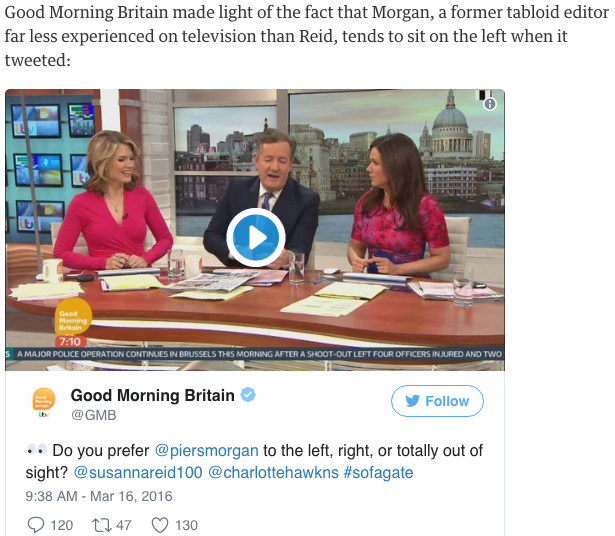
BBC Breakfast seating bias due to 'misogyny', says ex-Countryfile host.
Monday, 25 January 2016
Pink products cost 37% more in UK
...and women's products are priced 7% higher than men's equivalents in the US too...
In December, an investigation by the New York City Department of Consumer Affairs found that in a study of nearly 800 products – from toys to personal items like shampoo – many were priced differently for men and women. Men’s razors went for $14.99, for example, while the same razors marketed toward women were being sold for $18.49. A pink Radio Flyer children’s scooter in pink was double the price of a red “boys’” version. In total, the investigation found that of the products they looked at, items were priced on average 7% more for women than those for men.
A report this month on products in the UK found something very similar: when it came to the same products marketed differently for men and women, there was a whopping 37% difference in price. Beauty products, toys, everything. It doesn’t even get better as you age: adding insult to injury, women are even charged more for adult diapers.
Monday, 12 October 2015
Femvertising
Interesting neologism [creating a new term] - the idea that feminism is being packaged and exploited by the very ad industry that has for so long (and continues to) inculcated sexism and negative gender stereotypes. This is actually part of a much older trait: powerful, challenging (counter-hegemonic) ideologies get undermined by being brought into advertising, losing their radical edge. Go back 40 years and look at how punk, an anarchic explosion of working-class discontent and challenge to corporate control through self-distribution, notably with ties to reggae and Afro-Caribbean culture, gave way to race riots as advertisers made the radical punks a colourful selling tool.
The article sampled below looks at other, older, examples, such as the Virginia Slim campaign to flog cancer sticks to women. Can these commercial ad campaigns be a force for positive change?
You can further examples in: Eight ads that shatter tired gender stereotypes.
This neologism notably came about through a hashtag...
It started, as these things now do, with a hashtag. Earlier this month, utility company EDF launched a campaign to encourage young girls to explore Stem-based careers (that’s jobs in science, technology, engineering and maths), reminding everyone that “only one in every seven” of these roles in the UK are held by women.
The way the UK’s second-biggest energy provider chose to help was to launch #prettycurious. The sell? “Sparking the imagination of young girls [and] inspiring them to stay curious about the world.” When the marketing team paid for by your electricity bill is selling female empowerment, “femvertising” is no longer a niche internet neologism, but a genuinely queasy chapter in feminism’s fourth wave.
Behold! The advertising industry, once bent on selling us sex is now selling us its disgust with sexism. Experts in the field might point to Virginia Slims, the godmother of allegedly feminist brands, selling female empowerment as far back as 1968. These were the ads that showed women sashaying, strutting and smoking with the tagline: “You’ve come a long way, baby”, making lung cancer an equal-opportunity disease.
Wednesday, 7 October 2015
Commutation test: Twilight gender-flipped in new Meyers book
Meyers has issued a 'fan fiction' (so-called despite being written by her, as it expresses a common fan trope) rewrite of Twilight which reverses the gender roles, with a drippy bloke clinging onto a purposeful chapette. Still sounds horrible, but it is another example of a growing trend of gender reversals, helping to add impetus and freshness to the unceasing torrent of often stinking remakes (another example, Battlestar Galactica, being a rare upgrade on the original), reimaginings - just think Ghosbusters...
Gender swapping is a powerful way to analyse the gendered nature of fiction. The more original and surprising the reworking is, the more tired and cliched the original almost certainly was. If it feels astounding to have a young guy besotted with an older, powerful woman, that is because the reverse was something we’d seen a thousand times before.Gender-swap Twilight should expose the flaws in the original – I can’t wait.
Subscribe to:
Posts (Atom)