Gender swapping is a powerful way to analyse the gendered nature of fiction. The more original and surprising the reworking is, the more tired and cliched the original almost certainly was. If it feels astounding to have a young guy besotted with an older, powerful woman, that is because the reverse was something we’d seen a thousand times before.Gender-swap Twilight should expose the flaws in the original – I can’t wait.
Showing posts with label film. Show all posts
Showing posts with label film. Show all posts
Wednesday, 7 October 2015
Commutation test: Twilight gender-flipped in new Meyers book
Meyers has issued a 'fan fiction' (so-called despite being written by her, as it expresses a common fan trope) rewrite of Twilight which reverses the gender roles, with a drippy bloke clinging onto a purposeful chapette. Still sounds horrible, but it is another example of a growing trend of gender reversals, helping to add impetus and freshness to the unceasing torrent of often stinking remakes (another example, Battlestar Galactica, being a rare upgrade on the original), reimaginings - just think Ghosbusters...

Monday, 13 May 2013
Brave: Merida sexualised for sequel?
A good illustration of basic points about how ideology permeates even seemingly bland, inoffensive fare such as Disney (though once you begin some wider reading you'd be alerted to the wealth of writing on the ideology behind The Mouse) comes with controversy over the redesigned animated character of Meridia for a pending Brave sequel.
Here's a sample quote from a detailed Guardian article (with illustrative pics + vids) on this:
Here's a sample quote from a detailed Guardian article (with illustrative pics + vids) on this:
Chapman, who was replaced by Mark Andrews part way through the production of Brave but maintained a co-director's credit, said Disney had completely missed the point when creating the new version of her creation. "I think it's atrocious what they have done to Merida," she wrote to her local newspaper, the Marin Independent Journal. "When little girls say they like it because it's more sparkly, that's all fine and good but, subconsciously, they are soaking in the sexy 'come-hither' look and the skinny aspect of the new version. It's horrible!Any thoughts on this? Add a comment below.
"Merida was created to break that mold," she added. "To give young girls a better, stronger role model, a more attainable role model, something of substance, not just a pretty face that waits around for romance."
Sunday, 2 September 2012
Teen girls in film: Heathers
The article below is lengthy and, at times, challenging, but contains useful points (from a certain feminist perspective) on a range of influential films featuring central female teen characters: Carrie + The Exorcist (70s); Pretty in Pink + The Breakfast Club (80s), Clueless + Legally Blond (90s/noughties), + Mean Girls. I'd add to this list the superb Canadian Indie Ginger Snaps, which makes for an interesting comparison with the more corporate, Hollywood-ised gloss of Twilight with its unsubtle religiously-inspired messages about female identity.
You may not agree with the views in the article below - there are many points I'd disagree with - but you will certainly find useful material to help contextualise your own work as filmmakers putting representations of gender on-screen, and reflecting (probably still quite unconsciously at this stage) contemporary ideas and ideologies in doing so.
Article URL: http://www.guardian.co.uk/film/2009/mar/22/heathers-mean-girls-hairspray
The Observer,Talking about bad girls
Michael Lehmann's 1988 masterpiece Heathers ushered in a new type of film, one in which schoolgirls were not simply one-dimensional caricatures, says Eva Wiseman
- Heathers
- Production year: 1989
- Country: USA
- Cert (UK): 18
- Runtime: 102 mins
- Directors: Michael Lehmann
- Cast: Christian Slater, Shannen Doherty, Winona Ryder
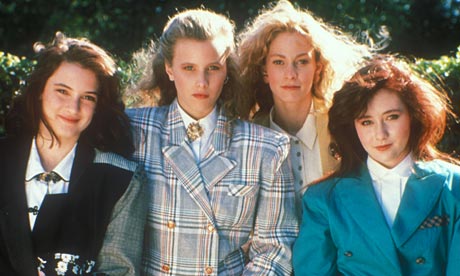
Girlhood is a horrid thing, a time awash with sebum, diaries read out loud and all your friends a desirable nine out of 10 to your un-gorgeous six. Lunch hours spent with your arms folded to mock up a cleavage and notes in the margin of a GCSE poetry textbook that, in the dim light of your parents' TV, take on such meaning, such teenage magnitude, that you're tearful by teatime.
The years before you leave home are largely nightmarish, or at least, through the haze of alcopops and hormones, for many of us they seemed that way. I never really knew the girls who were having the times of their lives - they moved faster. They got the boys they wanted, they learned to manage and maintain all the embarrassments of puberty within a single half-term. But one thing they never "got" the way we did, with our lank hair and uneven skin tone, were certain films. Heathers (the 1988 murder comedy starring 16-year-old Winona Ryder as Veronica Sawyer, a breakaway member of a popular girl gang), with its poisoned cheerleaders and vision of high school as a Technicolor battleground, spoke to us, the girls who didn't quite fit in.
The teenage girl on film, says Kate Random Love, a feminist theorist, "is a wonderful barometer for measuring a culture's fantasies and anxieties about femininity at the time. For example, it's surely no coincidence that in the 1970s - the decade that began with the second wave of feminist uprisings - the most notable representations of female adolescence were in horror films such as The Exorcist and Carrie. Femininity itself became a monstrous force rising up with the potential to destroy everything." In the 1980s, the teenage girl on film (Pretty in Pink, The Breakfast Club) was obsessed with cash; in the 1990s and early 2000s she was a beacon of spiritual development (Clueless, Legally Blonde) and dangerous sexuality (But I'm a Cheerleader, Boys Don't Cry). "Since then, teen girls in film have become more complex and less one-dimensional, and invite a much more ambivalent response from the viewer - in Mean Girls [2004] we spend a lot of our time actually hating Cady Heron, the main protagonist," says Random Love.
Subscribe to:
Posts (Atom)