Thursday, 14 March 2013

Book Publishing industry: sexist, male gaze?

ADDITION, 13.5.13: 'COVERFLIP' - Can't see the gallery I also looked at when I read this a few days ago, but here's an interesting article about how women writers see their potential market reduced by heavily, stereotypically feminised covers, regardless of the book's themes or genre, putting off male readers. Author Maureen Johnson took to Twitter to vent spleen on this, and a series of 'coverflipped' reimagininbgs emerged, re-casting classic novels by male writers as if they'd been written by female authors and marketed accordingly by an outmoded publishing industry.

Marking the 40th anniversary of the launch of a publisher for writing by women largely ignored by the publishing industry, this article surveys the state of the industry today, and finds that women writers are still under-represented in terms of books reviewed. Here's a sample from the article:
Gay's survey followed the work of the group Vida: Women in Literary Arts, which has been publishing an annual count of women's representation in literary journals for three years. Its most recent count came out last week – not one of the literary publications it analysed reviewed more books by female authors than male authors.

Thursday, 14 February 2013

She-Hulk ... needs a man

Read the full article here.
News that comic book publisher Marvel, rights-holder of many of the hit superhero franchises of recent years, is seeking to boost its appeal to a female demographic by creating long-form novelisations centred on two female superheroes...

They argue this is a great example of progressive thinking, and that these novels should appeal equally to male and female audiences. Here's a more critical take on this, from a critic essentially arguing they're doing what tech companies do (make it pink!), in this case focussing on romance:
Not all potential readers were impressed, however. "If the comic book industry thinks that this is the answer to their woman problem, well, they're worse off than we originally imagined," wrote Alicia Lutes at Hollywood . "The novels purport to 'showcase strong, smart heroines', but seemingly relegate their stories to 'seeking happiness and love', as if those are the only two things women are programmed to care about, ever… Here's an unpopular opinion, comic book industry: Why don't we first work on making our female superheroes more than just spandex-tinged boobholders meant to tantalise and frustrate the predominately male audience that reads them?"
Sci-fi and superhero movies tend to be fairly straightforward reflections of the male gaze theory and the objectification of women on screen (and across most mainstream media). Women tend to be clad in skin-tight, revealing costumes - it seems thats what all humanoid females, of any species, do!
Star Trek's 6 of 9 (Jerry Ryan): blatantly targeting a male audience?
Whatever your thoughts on this (which you can always share), there is at least some countertyping counter-hegemony (the muscular, physical strength) to go alongside the normative stereotyping (glamorous, focus on body/looks, romance as central).
Read the full article here.
Avatar's Neytiri: even animated characters fit the general rule

Tuesday, 23 October 2012

1974-2012: ONE US TV show led by black actress

[cross-posted from Rep. of Ethnicity blog]
Useful stat, and insight into the barriers that ethnicity still poses for black actresses: there were zero US TV dramas fronted by a black actress after 1974, until now (Oct 2012). Just a 38-year gap!!!
That would be a helpful stat to quote if ethnicity came up in your exam (wider context).
Article below URL.

American television's real Scandal

Why have audiences had to wait 38 years for a black female lead character?
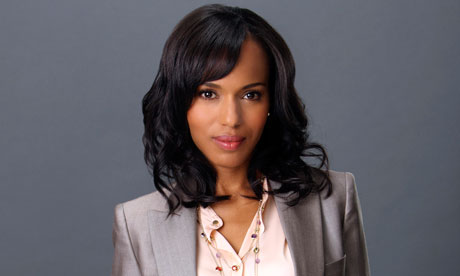
KERRY WASHINGTON
Kerry Washington, star of Scandal. Photograph: Craig Sjodin/ABC
When Scandal, the new drama about political corruption in the US capital starring Kerry Washington was first previewed in America, the show's creator Shonda Rhimes remarked, somewhat caustically: "I think we were at a place where a non-white actor can be the lead in a television series a long time ago – I just think that people have failed to cast the actors they should have been casting."
Surprisingly, Washington is the first black female lead on network television in 38 years. Not since 1974 when Tessa Graves starred as a policewoman in the blaxploitation show Get Christie Love! has a primetime US network show featured a black woman as the main character.
Since then the roles for black actresses have typically been limited to supportive friend or snappy sidekick. Most recently, former Doctor Who star Freema Agyeman landed a supporting role in the upcoming Sex and the City prequel, The Carrie Diaries, fellow Brit Gugu Mbatha-Raw played one half of a husband/wife spy team in the swiftly cancelled Undercovers and former reality star Nene Leakes had turns in Glee and sitcom The New Normal.
Even Miranda Bailey, arguably the strongest character on the show that made Shonda Rhimes's name – Grey's Anatomy – is frequently relegated to the sidelines in favour of another smooch between Meredith and McDreamy.

Friday, 5 October 2012

Ikea/Starbucks take women out of the picture

Two of the most recognisable faces of globalisation have shown an ugly side in recent times, Photoshopping women out of advertising materials in an effort to appeal to customers in Saudia Arabia. Full story below from http://www.guardian.co.uk/world/2012/oct/02/ikea-apologises-removing-women-saudi-arabia-catalogue:

Ikea apologises over removal of women from Saudi Arabia catalogue

Company says airbrushing women out of pictures showcasing company's products goes against its values
Ikea catalogue
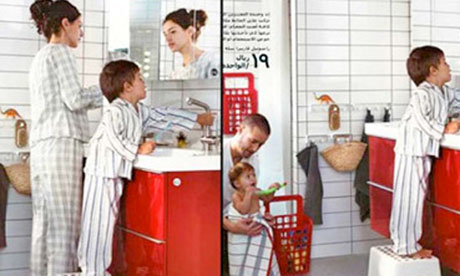
The orginal version of the Ikea catalogue and the censored version circulated in Saudi Arabia.
Ikea, the global furniture company, has apologised for deleting images of women from the version of its catalogue circulating in Saudi Arabia.
The issue was highlighted on Monday by the free newspaper, Metro, which compared the Swedish and Saudi versions of the catalogue and showed that women had been airbrushed out of otherwise identical pictures showcasing the company's products.
Ikea's Saudi catalogue, which is also available online, looks the same as other editions of the publication, except for the absence of women.
One picture shows a family apparently getting ready for bed, with a young boy brushing his teeth in the bathroom. However, a pyjama-clad woman standing next to the boy is missing from the Saudi version. Another picture of five women dining has been removed in the Saudi edition.
Ikea released a statement expressing regret over the issue, saying: "We should have reacted and realised that excluding women from the Saudi Arabian version of the catalogue is in conflict with the Ikea Group values."
Women appear only infrequently in Saudi advertising, mostly on Saudi-owned television channels that show women in long dresses, with scarves covering their hair and long sleeves. In imported magazines, censors black out many parts of a woman's body including arms, legs and chest.
When Starbucks opened its coffee shops in Saudi Arabia, it removed the long-haired woman from its logo, keeping only her crown.
Sweden's equality minister, Nyamko Sabuni, said Ikea was a private company that made its own decisions, but added that it also projected an image of Sweden around the world.
"For Ikea to remove an important part of Sweden's image and an important part of its values in a country that more than any other needs to know about Ikea's principles and values, that's completely wrong," Sabuni told the Associated Press.
Ikea Group, one of the many branches in the company's complicated corporate structure, said it had produced the catalogue for a Saudi franchisee outside the group.
"We are now reviewing our routines to safeguard a correct content presentation from a values point-of-view in the different versions of the Ikea catalogue worldwide," it said.

Monday, 24 September 2012

Femen: radical feminist protest movement

I raise this as a potentially useful concept to include in your consideration of representation issues. This is a feminist protest group that is using nudity to protest at the sexist, misogynistic patriarchy that they believe dominates global culture.

Its pertinent to analysis of music videos and slasher films as each feature near-nudity or nudity frequently, with artists such as Madonna, Rihanna and Lady Gaga clearly trading on their bodies and sexual appeal ... BUT claiming (as post-feminists would argue) to be strong women in control and expressing themselves, rather than victims of the male gaze. The slasher movie is often criticised for its wide use of female nudity, though these feminist campaigners are partly making the point that women have long been encouraged to feel ashamed of their bodies - can a seemingly sexist genre really be reclaimed as a positive expression of female liberation?!

The starkly contrasting ways in which traditional feminists and post-feminists (who believe that equality of the sexes has been achieved, so its outmoded to perceive women as victims of a male-dominated culture, or patriarchal society) read media texts is certainly something for you to consider when analysing your own work as well as existing media texts.

NB: the web page contains a topless image, so if you do follow the link take care not to do so in a school setting or around younger siblings. I've copied in the full article below so you needn't do so!
ARTICLE: http://www.guardian.co.uk/world/2012/sep/22/femen-topless-warriors-global-feminism

In a chaotic and crumbling former public washhouse in a rundown district of northern Paris, Inna Shevchenko was explaining how a large leather punchbag hanging from the rafters might be used by the foot soldiers of a new generation of feminists.
As she prepared to welcome recruits to the Ukrainian-based feminist group Femen's first "international training camp", it was clear that the instruction would not be all ideological. The talk was of "war", "soldiers", "terrorism" and "enemies". Was it not curious, one French journalist asked, that Inna and her warriors had adopted the language of combat, traditionally a male domain, to describe their mission?
Was it not also inconsistent, another asked, that the new feminists were using nakedness to rail against female exploitation? In a week that had seen the banning of photographs of a topless Duchess of Cambridge, it was certainly topical.
"Ah, but we have a different idea; we are talking about peaceful war, peaceful terrorism," Inna said. "We are taking off our clothes so people can see that we have no weapons except our bodies. It's a powerful way to fight in a man's world. We live with men's domination and this is the only way to provoke them, the only way to get attention.
"We don't hide our bodies, we don't hide our faces, we confront our enemies face to face. We look them in the eyes and we have to be well prepared physically for that."
There was, she explained patiently, no contradiction in going topless or naked to protest against what they view as the three main evils of a global "patriarchal society": sexual exploitation, dictatorship and religion. Protesting naked, as Femen's slogans insist, is liberté, a reappropriation of their own bodies as opposed to pornography or snatched photographs which are exploitation.
On a less intellectual level, taking their clothes off ensures a lot of publicity.

Sunday, 2 September 2012

Teen girls in film: Heathers

The article below is lengthy and, at times, challenging, but contains useful points (from a certain feminist perspective) on a range of influential films featuring central female teen characters: Carrie + The Exorcist (70s); Pretty in Pink + The Breakfast Club (80s), Clueless + Legally Blond (90s/noughties), + Mean Girls. I'd add to this list the superb Canadian Indie Ginger Snaps, which makes for an interesting comparison with the more corporate, Hollywood-ised gloss of Twilight with its unsubtle religiously-inspired messages about female identity.

You may not agree with the views in the article below - there are many points I'd disagree with - but you will certainly find useful material to help contextualise your own work as filmmakers putting representations of gender on-screen, and reflecting (probably still quite unconsciously at this stage) contemporary ideas and ideologies in doing so.

Article URL: http://www.guardian.co.uk/film/2009/mar/22/heathers-mean-girls-hairspray

Talking about bad girls

Michael Lehmann's 1988 masterpiece Heathers ushered in a new type of film, one in which schoolgirls were not simply one-dimensional caricatures, says Eva Wiseman
 The Observer,
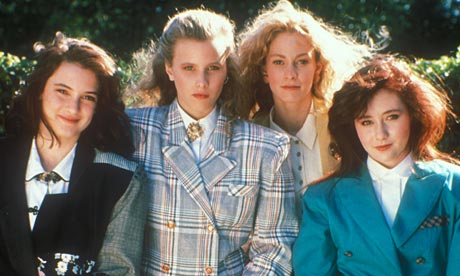
Heathers film still
The Heathers gang: from left, Winona Ryder, Kim Walker, Lisanne Falk and Shannen Doherty. Photograph: 20th Century Fox/Rex Features
  1. Heathers
  2. Production year: 1989
  3. Country: USA
  4. Cert (UK): 18
  5. Runtime: 102 mins
  6. Directors: Michael Lehmann
  7. Cast: Christian Slater, Shannen Doherty, Winona Ryder
  8. More on this film
Girlhood is a horrid thing, a time awash with sebum, diaries read out loud and all your friends a desirable nine out of 10 to your un-gorgeous six. Lunch hours spent with your arms folded to mock up a cleavage and notes in the margin of a GCSE poetry textbook that, in the dim light of your parents' TV, take on such meaning, such teenage magnitude, that you're tearful by teatime.
The years before you leave home are largely nightmarish, or at least, through the haze of alcopops and hormones, for many of us they seemed that way. I never really knew the girls who were having the times of their lives - they moved faster. They got the boys they wanted, they learned to manage and maintain all the embarrassments of puberty within a single half-term. But one thing they never "got" the way we did, with our lank hair and uneven skin tone, were certain films. Heathers (the 1988 murder comedy starring 16-year-old Winona Ryder as Veronica Sawyer, a breakaway member of a popular girl gang), with its poisoned cheerleaders and vision of high school as a Technicolor battleground, spoke to us, the girls who didn't quite fit in.
The teenage girl on film, says Kate Random Love, a feminist theorist, "is a wonderful barometer for measuring a culture's fantasies and anxieties about femininity at the time. For example, it's surely no coincidence that in the 1970s - the decade that began with the second wave of feminist uprisings - the most notable representations of female adolescence were in horror films such as The Exorcist and Carrie. Femininity itself became a monstrous force rising up with the potential to destroy everything." In the 1980s, the teenage girl on film (Pretty in Pink, The Breakfast Club) was obsessed with cash; in the 1990s and early 2000s she was a beacon of spiritual development (Clueless, Legally Blonde) and dangerous sexuality (But I'm a Cheerleader, Boys Don't Cry). "Since then, teen girls in film have become more complex and less one-dimensional, and invite a much more ambivalent response from the viewer - in Mean Girls [2004] we spend a lot of our time actually hating Cady Heron, the main protagonist," says Random Love.

Saturday, 4 August 2012

Belgian short causes waves

This is a good illustration of how non-commercial 'amateur' or academic media productions have the potential to influence discourse and public opinion as much as representations within major romcoms, TV soaps etc...

Exasperated at enduring catcalls and more every time she walked out of her front door in Belgium, this student made her final course production a doc on this - and sparked a debate about criminalising such behaviour in both France and Belgium: see http://www.guardian.co.uk/world/2012/aug/03/belgium-film-street-harassment-sofie-peeters