Monday, 24 September 2012

Femen: radical feminist protest movement

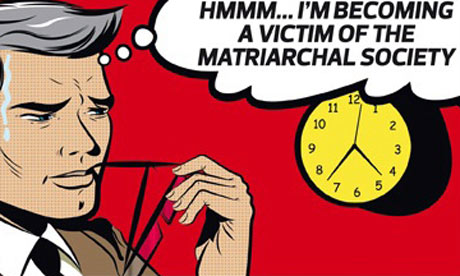
I raise this as a potentially useful concept to include in your consideration of representation issues. This is a feminist protest group that is using nudity to protest at the sexist, misogynistic patriarchy that they believe dominates global culture.

Its pertinent to analysis of music videos and slasher films as each feature near-nudity or nudity frequently, with artists such as Madonna, Rihanna and Lady Gaga clearly trading on their bodies and sexual appeal ... BUT claiming (as post-feminists would argue) to be strong women in control and expressing themselves, rather than victims of the male gaze. The slasher movie is often criticised for its wide use of female nudity, though these feminist campaigners are partly making the point that women have long been encouraged to feel ashamed of their bodies - can a seemingly sexist genre really be reclaimed as a positive expression of female liberation?!

The starkly contrasting ways in which traditional feminists and post-feminists (who believe that equality of the sexes has been achieved, so its outmoded to perceive women as victims of a male-dominated culture, or patriarchal society) read media texts is certainly something for you to consider when analysing your own work as well as existing media texts.

NB: the web page contains a topless image, so if you do follow the link take care not to do so in a school setting or around younger siblings. I've copied in the full article below so you needn't do so!
ARTICLE: http://www.guardian.co.uk/world/2012/sep/22/femen-topless-warriors-global-feminism

In a chaotic and crumbling former public washhouse in a rundown district of northern Paris, Inna Shevchenko was explaining how a large leather punchbag hanging from the rafters might be used by the foot soldiers of a new generation of feminists.
As she prepared to welcome recruits to the Ukrainian-based feminist group Femen's first "international training camp", it was clear that the instruction would not be all ideological. The talk was of "war", "soldiers", "terrorism" and "enemies". Was it not curious, one French journalist asked, that Inna and her warriors had adopted the language of combat, traditionally a male domain, to describe their mission?
Was it not also inconsistent, another asked, that the new feminists were using nakedness to rail against female exploitation? In a week that had seen the banning of photographs of a topless Duchess of Cambridge, it was certainly topical.
"Ah, but we have a different idea; we are talking about peaceful war, peaceful terrorism," Inna said. "We are taking off our clothes so people can see that we have no weapons except our bodies. It's a powerful way to fight in a man's world. We live with men's domination and this is the only way to provoke them, the only way to get attention.
"We don't hide our bodies, we don't hide our faces, we confront our enemies face to face. We look them in the eyes and we have to be well prepared physically for that."
There was, she explained patiently, no contradiction in going topless or naked to protest against what they view as the three main evils of a global "patriarchal society": sexual exploitation, dictatorship and religion. Protesting naked, as Femen's slogans insist, is liberté, a reappropriation of their own bodies as opposed to pornography or snatched photographs which are exploitation.
On a less intellectual level, taking their clothes off ensures a lot of publicity.

Sunday, 2 September 2012

Teen girls in film: Heathers

The article below is lengthy and, at times, challenging, but contains useful points (from a certain feminist perspective) on a range of influential films featuring central female teen characters: Carrie + The Exorcist (70s); Pretty in Pink + The Breakfast Club (80s), Clueless + Legally Blond (90s/noughties), + Mean Girls. I'd add to this list the superb Canadian Indie Ginger Snaps, which makes for an interesting comparison with the more corporate, Hollywood-ised gloss of Twilight with its unsubtle religiously-inspired messages about female identity.

You may not agree with the views in the article below - there are many points I'd disagree with - but you will certainly find useful material to help contextualise your own work as filmmakers putting representations of gender on-screen, and reflecting (probably still quite unconsciously at this stage) contemporary ideas and ideologies in doing so.

Article URL: http://www.guardian.co.uk/film/2009/mar/22/heathers-mean-girls-hairspray

Talking about bad girls

Michael Lehmann's 1988 masterpiece Heathers ushered in a new type of film, one in which schoolgirls were not simply one-dimensional caricatures, says Eva Wiseman
 The Observer,
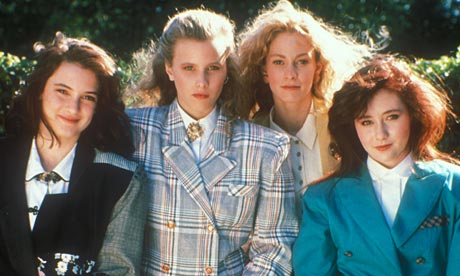
Heathers film still
The Heathers gang: from left, Winona Ryder, Kim Walker, Lisanne Falk and Shannen Doherty. Photograph: 20th Century Fox/Rex Features
  1. Heathers
  2. Production year: 1989
  3. Country: USA
  4. Cert (UK): 18
  5. Runtime: 102 mins
  6. Directors: Michael Lehmann
  7. Cast: Christian Slater, Shannen Doherty, Winona Ryder
  8. More on this film
Girlhood is a horrid thing, a time awash with sebum, diaries read out loud and all your friends a desirable nine out of 10 to your un-gorgeous six. Lunch hours spent with your arms folded to mock up a cleavage and notes in the margin of a GCSE poetry textbook that, in the dim light of your parents' TV, take on such meaning, such teenage magnitude, that you're tearful by teatime.
The years before you leave home are largely nightmarish, or at least, through the haze of alcopops and hormones, for many of us they seemed that way. I never really knew the girls who were having the times of their lives - they moved faster. They got the boys they wanted, they learned to manage and maintain all the embarrassments of puberty within a single half-term. But one thing they never "got" the way we did, with our lank hair and uneven skin tone, were certain films. Heathers (the 1988 murder comedy starring 16-year-old Winona Ryder as Veronica Sawyer, a breakaway member of a popular girl gang), with its poisoned cheerleaders and vision of high school as a Technicolor battleground, spoke to us, the girls who didn't quite fit in.
The teenage girl on film, says Kate Random Love, a feminist theorist, "is a wonderful barometer for measuring a culture's fantasies and anxieties about femininity at the time. For example, it's surely no coincidence that in the 1970s - the decade that began with the second wave of feminist uprisings - the most notable representations of female adolescence were in horror films such as The Exorcist and Carrie. Femininity itself became a monstrous force rising up with the potential to destroy everything." In the 1980s, the teenage girl on film (Pretty in Pink, The Breakfast Club) was obsessed with cash; in the 1990s and early 2000s she was a beacon of spiritual development (Clueless, Legally Blonde) and dangerous sexuality (But I'm a Cheerleader, Boys Don't Cry). "Since then, teen girls in film have become more complex and less one-dimensional, and invite a much more ambivalent response from the viewer - in Mean Girls [2004] we spend a lot of our time actually hating Cady Heron, the main protagonist," says Random Love.

Saturday, 4 August 2012

Belgian short causes waves

This is a good illustration of how non-commercial 'amateur' or academic media productions have the potential to influence discourse and public opinion as much as representations within major romcoms, TV soaps etc...

Exasperated at enduring catcalls and more every time she walked out of her front door in Belgium, this student made her final course production a doc on this - and sparked a debate about criminalising such behaviour in both France and Belgium: see http://www.guardian.co.uk/world/2012/aug/03/belgium-film-street-harassment-sofie-peeters

Friday, 18 May 2012

Do MALES suffer worst sexism?

Provocative argument in an article at http://www.guardian.co.uk/society/2012/may/13/men-victims-new-oppression that men suffer worse sexism than women, a claim made in a new book by South African philosophy professor David Benatar - one of several to be publsihed recently making similar claims. The article provoked an incredible 746 comments!

You can read a rebuttal of this claim by feminist columnist Suzanne Moore at http://www.guardian.co.uk/commentisfree/2012/may/16/second-sexism-men-blaming-feminism.

Lagging at school, the butt of cruel jokes: are males the new Second Sex?

They work longer hours, face economic insecurity and suffer worse health. Now their feckless ways are lampooned in the media. A controversial new book argues that men increasingly face a prejudice that dare not speak its name
Graphic
Men are the victims of reverse sexism, according to a new book.
You might not have realised it, but men are being oppressed. In many walks of life, they are routinely discriminated against in ways women are not. So unrecognised is this phenomenon that the mere mention of it will appear laughable to some.
That, at least, is the premise of a book by a South African philosophy professor which claims that sexism against men is a widespread yet unspoken malaise. In The Second Sexism, shortly to be published in the UK, David Benatar, head of the philosophy department at Cape Town University, argues that "more boys drop out of school, fewer men earn degrees, more men die younger, more are incarcerated" and that the issue is so under-researched it has become the prejudice that dare not speak its name.

Wednesday, 7 March 2012

Sexist remarks and wolf-whistles could become criminal offences

Salacious whistles and sexist comments may fall foul of new laws against sexual harassment to which Britain is signing up, the prime minister will announce on Thursday. 
The pledge to criminalise "verbal, non-verbal or physical" sexual harassment is one of the commitments in the Council of Europe's convention on violence against women, which David Cameron will commit to signing at a special event to mark International Women's Day. 
Among the pledges in the convention, which has already been signed by 18 countries including Germany, France and Ukraine, is one to pass legislation or other measures to criminalise or impose other sanctions for "unwanted verbal, non-verbal or physical conduct of a sexual nature with the purpose or effect of violating the dignity of a person, in particular when creating an intimidating, hostile, degrading, humiliating or offensive environment".
See http://www.guardian.co.uk/society/2012/mar/08/sexist-comments-to-become-criminal-offence

Tuesday, 6 March 2012

FEMINISM/Annie Lennox

I've briefly posted on AL before (on MusiVidz blog); her 80s vids for Eurythmics caused a national outcry [Chomsky: flak] when she played with gender expectations by dressing as a man

Fascinating article here (from the Guardian) in which she discusses this past and her efforts today to use music for feminist ends, including launching a new pressure group

Sunday, 25 September 2011

How success of film Bridesmaids brought change to US TV

A long article with good detail about the current wave of female-led comedies on US TV which are pushing boundaries and causing a real outcry, not least for their wisecracking leads playing such countertypes and transgressing the gender boundary with much risque, traditionally male, humour.
Could this simply be the 'ladette' phenomenon again though?

All this has come about after Hollywood executives noted the ability of Bridesmaids, a seeming chick-flick comedy, to attract a large male audience to cinemas. ... A useful point to consider when addressing your coursework's target audience.

Female comics take over US sitcoms following success of Bridesmaids

American TV executives wake up to fact that wisecracking women don't need male foils to be funny

24.9.11

    zooey deschanel
    Female comedians and actors such as Zooey Deschanel are leading the new wave of US sitcoms


    Something strange is afoot in the world of the American sitcom. A breed of character has emerged that curses profanely, talks frankly about sex, sleeps around and drinks too much, all while wisecracking rudely with the best of them.
    None of those attributes is especially original, except that these characters are all women. A fresh crop of TV comedy shows has hit the US cultural landscape anchored on a new breed of sassy, independent, freethinking woman.
    Building on the success of the hit Hollywood movie Bridesmaids, which seemed to convince movie executives that male cinemagoers would pay to see funny women, America's television channels are now also placing a big bet on a feminine twist to some tried and tested comic set-ups.
    They have even raided the worlds of independent cinema and cutting-edge stand-up to get their talent. First up is New Girl, which stars indie darling Zooey Deschanel in her own show about a woman called Jess who moves in with three men. Though it is an ensemble cast, the show is firmly centred on Deschanel as its main draw. Next is 2 Broke Girls, which features another star of the independent scene, Kat Dennings. She plays Max, a gritty waitress with a strong line in witty put-downs that have stretched what is previously tolerated on mainstream TV. In the first show – on the CBS network no less – Dennings's Max responds angrily to a restaurant customer who clicks his fingers at her to get her to come to his table. "You think this is the sound that gets you service," she says, clicking her fingers right back. "I think this is the sound that dries up my vagina." That line alone inspired a wave of hand-wringing articles in America wondering about current broadcasting standards.
    Finally, there is Whitney, a show that stars Whitney Cummings, a rising stand-up comedian who has drawn rave reviews for her comic routines. Now she has been given her own TV show. The format is standard – it explores Whitney's life as she lives with (and refuses to marry) her boyfriend – but network executives have been promising the show will not pull its punches in dealing frankly with sex and relationships. "This has been coming for a while. A lot depends on these shows. If people respond well to them, then that is all we are going to see. If not, then we'll have to wait another five years to try again," said Janette Barber, a stand-up comic turned radio host on SiriusXM satellite radio.
    Of course, there is a long tradition of sassy, funny women in US television comedy. From almost the very start of the genre, major female stars emerged, like Lucille Ball in the classic 1950s show I Love Lucy. In the 70s Bea Arthur starred in Maude as an outspoken liberal, while Loretta Swit was nominated for 10 Emmys during 11 years in M*A*S*H. In the late 80s Roseanne Barr, as the lead character in Roseanne took a wisecracking female lead character to new heights. However, those series nearly always placed their female comics in the role of a wife or mother. With a few notable exceptions – such as the TV news comedy show Murphy Brown – they were set against a husband or with a family.
    That phenomenon reached its apogee with a wave of comedy shows in the 2000s which seemed to make a fetish of placing attractive, intelligent and witty women in roles where they played second fiddle to often overweight and not especially clever husbands. Shows like The King of Queens, Everybody Loves Raymond and According to Jim were enormously successful using this formula. "We were seeing a lot of this. The pretty, attractive woman who lives with a schlubby guy. Why did these women marry these guys? They are brighter and more intelligent and more funny than their husbands, who clearly often infuriate them," said Professor Robert Thompson, a pop culture expert at Syracuse University.
    The new TV comedies are helping to end that. Here the women characters are not defined by men, even as they fulfil some of the cliches of the sitcom genre: by getting dumped, or trying to bring spice back into a relationship or going on a first date. They put the woman character first and are building on a number of recent female successes, especially Tina Fey's award-winning role in 30 Rock and to a lesser extent the Amy Poehler-led comedy Parks & Recreation.
    But the largest influence is the runaway critical and commercial success of Bridesmaids, which starred and was co-written by Kristen Wiig. That movie blew away the critics with its focus on female friendships and, far more importantly in the minds of entertainment executives, it cashed in at the box office in spectacular style. It notched up a staggering $283m in ticket sales, on a budget of just $32m: a paper profit of almost a quarter of a billion. No wonder a host of follow-up films, such as the upcoming Bachelorette, are now in the works. And no surprise that America's TV executives hope to cash in with their female-centric shows. "New things don't happen on TV. They happen somewhere else and TV gloms on to them. The audience for Bridesmaids had a lot of purchasing power and they want a piece of that," said Barber.
    That clear-eyed focus on the bottom line is gradually shaking up US television's natural conservatism when it comes to recognising social change. After all, American life is filled with several generations of independent, working (funny) women unconstrained by their men. But TV, many experts say, has a history of being slow to catch up with the society it claims to reflect. Thompson points to the success of the 1960s comedy show Gomer Pyle U.S.M.C. Despite being set on a marines base during the brutal height of the Vietnam war, the show never once mentioned the conflict. Instead it focused on the daily tribulations of its main character, a former petrol station attendant who had signed on in the military. Or look at the furore surrounding the coming out of Ellen DeGeneres as a lesbian on her sitcom Ellen in 1997. Though it became a momentous event in TV history, gay people in actual public life in America were already prominent and had long won numerous civil rights and social acceptance. But with these new shows it is possible that the medium is at last catching up with the reality of everyday life. "We are finally at the point when TV is not so many steps behind. Soon it might even sometimes be a few steps ahead," said Thompson.
    However, there is still a way to go when it comes to the treatment of women in comedy. It has long been a male-dominated world. "I'm saddened that we are still talking about women in comedy as if it were an oddity. When I first started doing stand-up in the 80s, I was usually introduced: 'And here's something different – a female comic!'," said Judy Carter, a comedian turned motivational speaker. Despite the wave of new women-led shows, there still does seem to be a double standard when it comes to female comics. They are not entirely judged on the quality of their jokes, but also on their gender, in a way male comics are not. Perhaps the new shows will help change that. To do so they will have to be successful in terms of ratings, thus generating the required advertising revenue to make them a standard part of the broadcasting ecosystem. The early signs are good.
    New Girl's debut scored some 10.1 million viewers and was the most popular show of its night among younger viewers. Meanwhile, 2 Broke Girls got a huge 19.2 million viewers for its heavily promoted first show. If such performances are kept up, the shows might cease to be viewed as sitcoms featuring funny women and just seen as funny TV shows. "I look forward to the day when we laugh at a movie such as Bridesmaids, and we don't even notice: 'Oh my God, women are funny!' Funny is funny regardless of gender," said Carter.